Oct 8th, 2026



This post is the first in our series examining the SEC's proposed rescission of Rules 611 and 610(e) of Regulation NMS.
Introduction
In 2005, when the Securities and Exchange Commission adopted Regulation NMS, it was trying to hold together a market that was pulling apart. Trading was fragmenting across a growing number of venues, and the Commission wanted to be sure that an investor's order could not be filled at a worse price on one venue while a better price sat displayed on another. Two rules did much of that work. Rule 611, the trade-through rule, prohibits a trading center from executing an order at a price inferior to a protected quotation displayed somewhere else. Rule 610(e) restricts the display of locked and crossed quotations. Together, they forced every venue trading NMS stocks into a kind of enforced price coordination.¹
Now the Commission has proposed to take both of them down. As the release recounts, Rule 611 has been likened to "the scaffolding of the national market system," a "temporary structure that can now be taken down because it is no longer necessary."² The Commission's own reasoning runs the same way: given the "highly automated and interconnected nature of our equity markets today," it writes, Rule 611 is "not needed to backstop a broker's duty of best execution," and the same advances in automation, interconnectivity, and access to market data "obviate the need for Rule 610(e)."²
It is worth being clear about what this is: a proposal, put out for public comment, not a final rule. Nothing has been rescinded. But a proposal to unwind two decades of market-structure plumbing deserves to be understood on its own terms before anyone argues for or against it, so this first post stays close to the Commission's own case. What do the rules actually do? What does the market look like now, compared with the one they were written for? And what is the cost structure the Commission points to when it says the rules have outlived their purpose? Our own position, and the five conditions we attached to it, come in the posts that follow.
What Does the SEC's Proposal Actually Do?
To see why the Commission thinks the rule may no longer be needed, it helps to remember the problem it was built to solve. A "trade-through" happens when one trading center executes an order at a price worse than a protected quotation displayed somewhere else: in effect, stepping over a better price that was sitting in plain view. In 2005, with liquidity scattering across venues and routing technology far less mature than it is today, the Commission worried that without a rule, those better prices might simply be passed by. Rule 611 made passing them by impermissible, and Rule 610(e) kept quotations from locking or crossing in ways that muddied the picture. Between them, the two rules turned a fragmented set of venues into a single, price-coordinated whole.¹
The proposal would rescind both rules for NMS stocks, along with certain defined terms, and make conforming amendments across the rest of Regulation NMS.¹ The premise behind it is that the conditions that justified the rules in 2005 no longer hold. Automation, interconnectivity, and competition, the Commission argues, now do the work the rule was built to guarantee, and the rule itself has become a source of the very complexity it was meant to tame. Rescinding it, the Commission writes, "would reduce the complexity in our equity market structure that has occurred since its adoption in 2005, which would in turn reduce costs for market participants and foster innovation and competition."²
Why Are Broker-Dealers Declining While Trading Venues Multiply?
The Commission grounds its case in two trends that, placed side by side, tell a striking story: over the last decade the market has been losing firms and gaining venues at the same time.
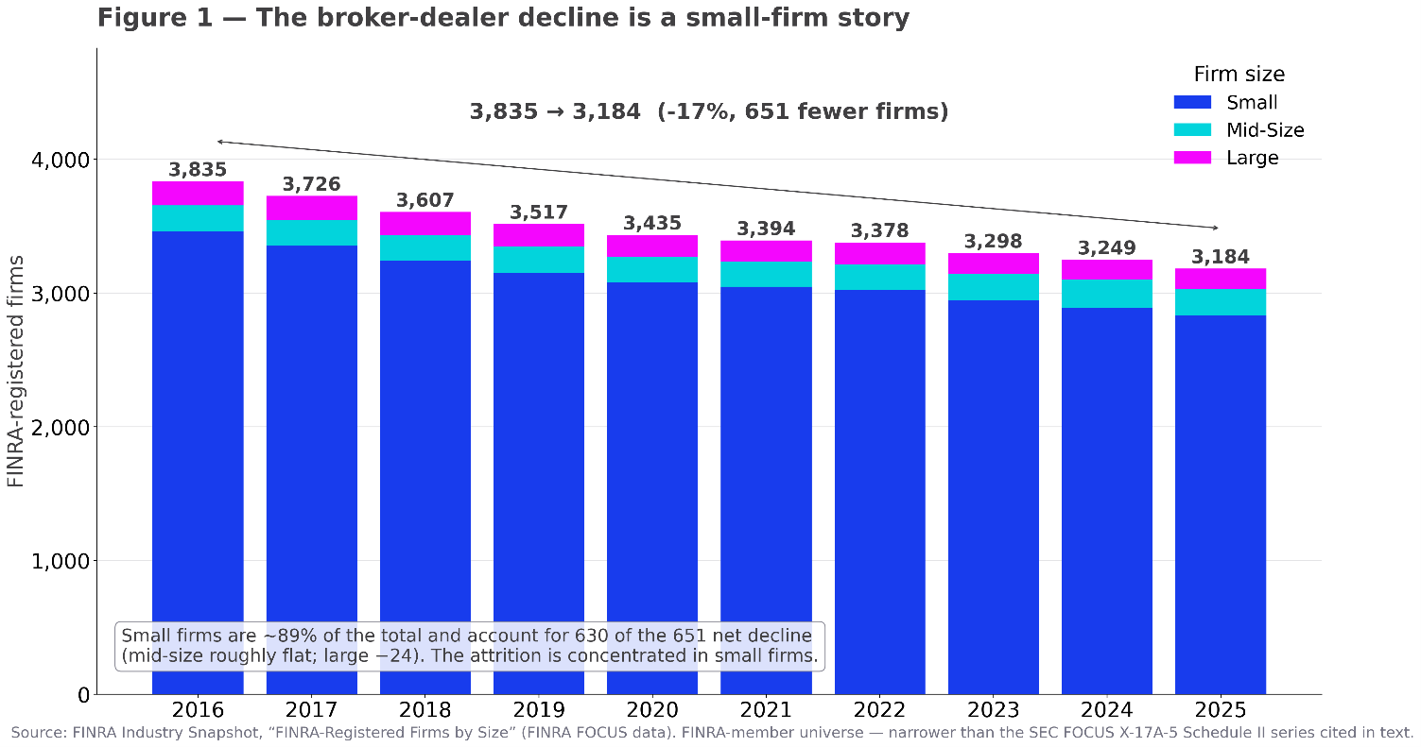
Start with the firms. The number of registered broker-dealers has fallen by roughly a quarter, from 4,450 in 2015 to 3,277 by the fourth quarter of 2025, measured on FOCUS Report Form X-17A-5 Schedule II, a decline the Commission describes as "increased concentration in the broker-dealer industry over the last decade."³
Figure 1 shows the composition of that decline, using a companion public series: the FINRA Industry Snapshot's count of registered firms by size. (This is the FINRA-member universe, a narrower group than the SEC's FOCUS series, so the totals are lower, but the direction is identical.) What the picture makes plain is that this is not an across-the-board contraction. Large and mid-size firm counts are essentially flat over the period. The decline is almost entirely a small-firm story: small firms make up the large majority of the population, and they account for nearly all of the firms that have disappeared. Whatever has been squeezing broker-dealers out of the business has been squeezing the small ones hardest.
Now the venues. Over the same stretch, trading has spread across more places, not fewer. In January 2026, NMS stocks traded on 17 national securities exchanges and across off-exchange venues that include 33 NMS Stock ATSs and other FINRA members.⁴ Two decades earlier, in 2005, eight exchanges traded NMS stocks.² So the market the proposal describes is almost a mirror image of the one Regulation NMS was written for: fewer firms competing to handle orders, spread across more venues that each demand to be reached.
Why Does Rule 611 Cost Small Broker-Dealers More Than Large Ones?
Why would more venues push the smaller firms out? The Commission's answer, and the heart of its cost case, is in how Rule 611 interacts with a growing number of exchanges. The rule does not, on its face, order any firm to connect to every exchange. But its practical effect comes very close. Because a trade may not execute through a protected quotation displayed anywhere, a firm has to be able to see and reach every protected quote, which means connecting to, and paying for data from, every exchange that displays one, no matter how little of the market that exchange represents. As one commenter put it, with evident exasperation, "all a new venue needs to do is post a quotation and the entire market must connect to its infrastructure, code to its systems and re-shape its trading algorithms to accommodate it."⁵
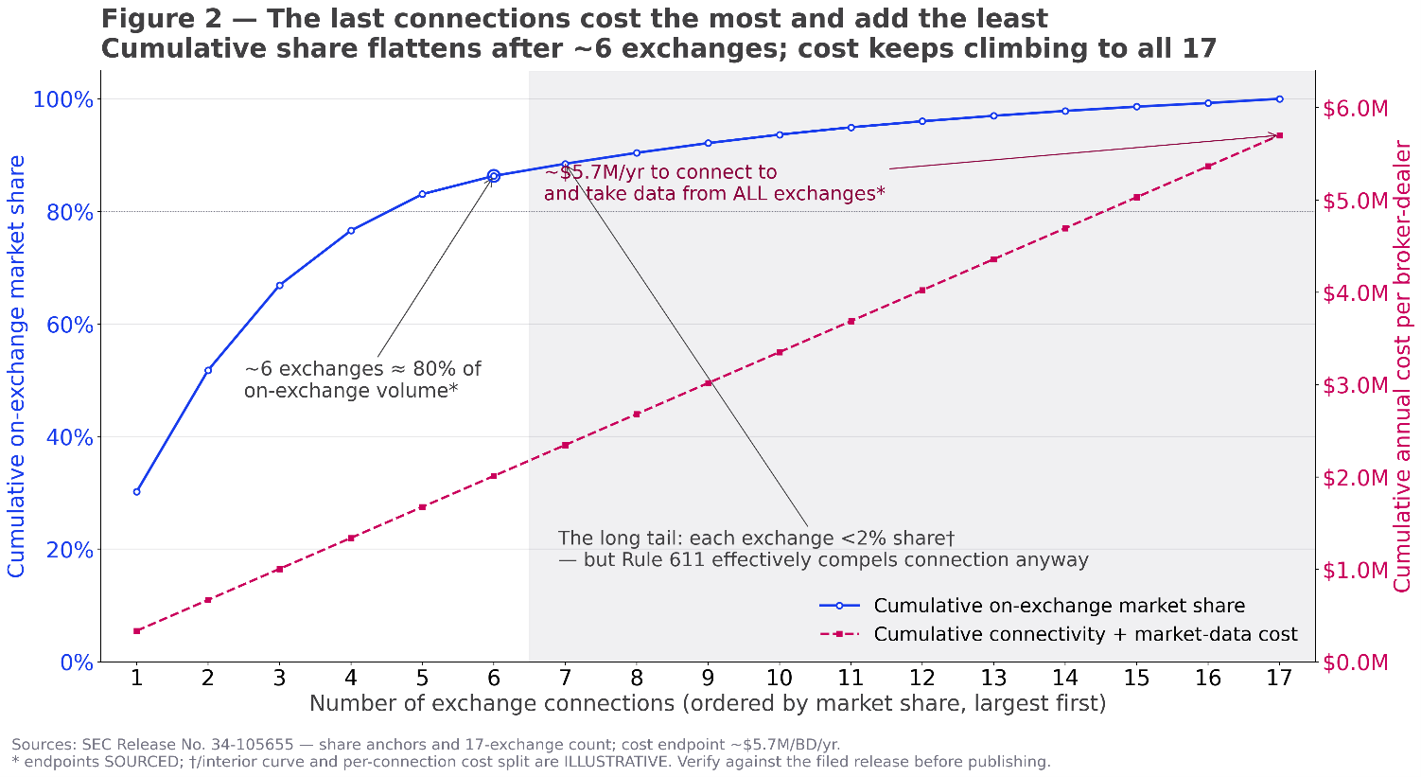
Figure 2 traces what that means for a firm's budget as it adds connections. The blue curve is cumulative market reach; the dashed curve is cumulative cost. They pull apart almost immediately. Roughly six exchanges account for about 80% of on-exchange volume, while the remaining venues each carry less than 2%, and yet the protected-quotation regime effectively compels a firm to connect to all of them anyway.⁵ The Commission estimates that connecting to and taking market data from every exchange runs about $5.7 million a year for a broker-dealer that connects to all of them.⁶ The shape of the two curves is the entire argument: the first handful of connections buys almost all of the reach, and every connection after that buys a sliver of volume at close to full price. The last connections cost the most and add the least.
For a large firm doing enormous volume, that fixed cost is an annoyance spread thin across a huge base. For a small firm, it is closer to a wall. And this is exactly where the Commission draws the line back to concentration: among the factors it names for the shrinking number of executing broker-dealers is that "data and connectivity costs, which can be significant, have risen as new exchanges begin charging data and connectivity fees," producing the kind of high fixed costs and scale economies that reward the largest players and disadvantage the rest.³
It is worth being precise about that link, because it is easy to overstate, and the temptation to overstate it is real. The Commission is not claiming (and neither are we) that connectivity cost single-handedly drove the decline in broker-dealers. The number of firms in this business moves for many reasons at once: consolidation, competition, margin pressure, shifts in how retail order flow is handled, and more. What the record shows is narrower and more defensible: the cost structure the rule created is one factor pointing in the same direction as the decline, and one the Commission itself puts on the list. That is a correlation with a plausible mechanism behind it, a reason to take the cost case seriously, not a proof that one thing caused the other.
A View From the Connectivity Layer
This is a cost structure we see from the inside. We comment on the proposal not as market-structure theorists but as builders of the order-management and connectivity technology that broker-dealers use to reach the market; Sterling Trading Tech operates a trading network with connectivity to more than 100 destinations, including direct connections to exchanges and broker-dealers.⁷ From that vantage, the Commission's factual premise is easy to credit. Broad, fast connectivity really is a present-day reality rather than an aspiration, and the market-structure conditions of 2005 have genuinely changed.
Closing
So the Commission's case, in its own words, is that Rules 611 and 610(e) have become scaffolding around a building that can now stand on its own: complexity and cost that no longer buy the protection they once did.² We agree with the direction of that argument and with its cost-reduction goal. The decline in registered broker-dealers, whatever its many causes, is consistent with precisely the kind of cumulative burden the proposal is trying to lift.⁸
But agreeing that scaffolding can come down is not the same as agreeing it can come down all at once, in any order, without first checking what it was holding up. That is the subject of the rest of this series, beginning in the next post, with the five conditions we attached to our support.
The full comment letter is available on the SEC's public comment file for File No. S7-2026-20: view the filing (https://www.sec.gov/comments/S7-2026-20/s7202620-997559-3142729.pdf).
Next: Where Sterling stands: support, with five conditions.
Footnotes
1. The Trade-Through Rule and Locked and Crossed Markets Provisions of Regulation NMS, SEC Release No. 34-105655 (File No. S7-2026-20) (proposed rule) (descriptions of Rule 611 and Rule 610(e); rescission for NMS stocks plus conforming amendments).
2. Id. (Rule 611 likened to "the scaffolding of the national market system" / a "temporary structure that can now be taken down because it is no longer necessary"; "highly automated and interconnected" markets; Rule 611 "not needed to backstop a broker's duty of best execution"; automation/interconnectivity "obviate the need for Rule 610(e)"; rescission would "reduce the complexity ... reduce costs ... and foster innovation and competition"; eight national securities exchanges traded NMS stocks in 2005).
3. Id. at n.565 (registered broker-dealers declined ~25%, 4,450 (2015) → 3,277 (Q4 2025), per FOCUS Report Form X-17A-5 Schedule II; "increased concentration"); factors contributing to concentration, including risen data and connectivity costs.
4. Id. at nn.562–563 (17 national securities exchanges; 33 NMS Stock ATSs; January 2026).
5. Id. at n.135 (commenter: "all a new venue needs to do is post a quotation and the entire market must connect ..."; six exchanges ≈ 80% of on-exchange volume; remaining exchanges each <2%) (O'Brien Letter; Robinhood Letter; FIA PTG) (commenter figures).
6. Id. at nn.467, 474 (SEC estimate: a broker-dealer that connects to all exchanges spends approximately $5.7 million per year on market data and connectivity fees).
7. Sterling Trading Tech, Comment on File No. S7-2026-20 (Aug. 10, 2026), at 1 ("trading network with connectivity to more than 100 destinations").
8. Id. at 1–2 ("STT supports the direction of the proposal"; the broker-dealer decline "has many causes" but is "consistent with the cumulative regulatory and operational burden that the proposal seeks to reduce").
We look forward to learning more about your trading needs.

What the SEC Is Proposing, and the Cost Structure Rule 611 Built
Blog Series: The 611 Question | Part ...

Sterling Trading Tech Launches STRIDER™
Designed to support traders in today’s increasingly global and extended-hours trading ...

Lime Trading Corp. Advances Equities Trading Capabilities by Pairing Its Low-Latency Execution Technology with Sterling Trader Pro
Lime Trading Corp. Advances Equities Trading Capabilities by Pairing Its Low-Latency ...

Sterling Trading Tech Implements Revised FINRA Rule 4210 for Lightspeed Financial
PDT Rule Now Eliminated and Replaced with New Intraday Margin Sterling Immediately Ready to ...
