Apr 16th, 2026



"This blog is part of Sterling Trading Tech’s series examining FINRA’s proposed intraday margin amendments to Rule 4210"
Introduction
FINRA’s proposed intraday margin framework is not only a shift in how margin risk is measured—it now comes with a defined path to implementation. Following approval, firms will have an initial 45-day window to begin adopting the new requirements, alongside a phased rollout period of up to 18 months.1
This timeline introduces both flexibility and urgency. While firms are not required to implement immediately, the transition effectively begins upon publication of the Regulatory Notice. FINRA also notes that firms adopting earlier may benefit from competitive advantages in attracting or retaining customers during the transition period, before broader industry adoption occurs.2
This post builds on our three-part series examining FINRA’s proposed intraday margin amendments to Rule 4210 — market scale, intraday risk formation, and the limits of trader classification—and turns to how firms implement intraday margin, why those implementation choices matter, and how timing may influence both operational outcomes and competitive positioning.
Series Recap: Modernizing Margin
How Firms Implement Intraday Margin—And Why It Matters
FINRA’s intraday margin proposal focuses on identifying the highest exposure that occurs during the trading day, rather than relying solely on end-of-day calculations.3 As described in FINRA’s March 2026 Intraday Margin Review materials, the framework centers on determining whether a customer’s account experiences an intraday margin deficit (IMD) at any point during the day.4
Importantly, the proposal provides firms with flexibility in how this exposure is measured and enforced. Intraday margin deficits may be computed retrospectively at the end of the day, and the rule does not require real-time margin calculations or pre-trade validation.5 This flexibility introduces a key distinction: firms may choose to measure intraday risk after it occurs, or to control exposure as it forms during the trading day.
From Measurement to Control
FINRA’s intraday margin examples illustrate that firms may take different approaches to managing exposure during the trading day. In one scenario, firms allow transactions to proceed even if they result in a negative intraday margin level, with deficits identified and managed after the fact. In another scenario, firms apply pre-trade controls that prevent transactions from executing if they would create a deficit.6
These approaches can be viewed as two distinct operational models: one in which exposure is allowed to exceed available margin and is addressed retrospectively, and another in which exposure is evaluated prior to execution and constrained at the point of order entry.
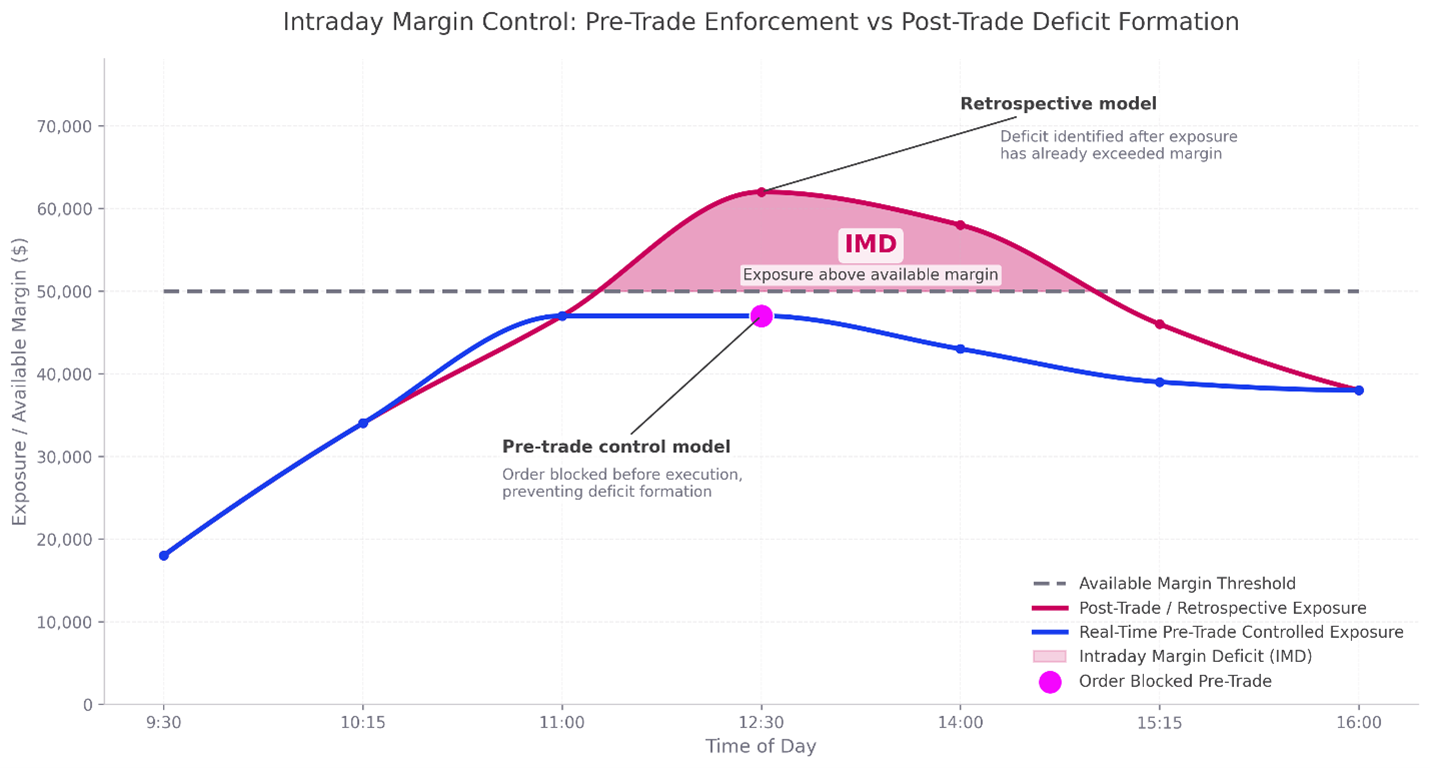 Figure 1: illustrates this distinction by comparing intraday exposure under these two approaches. As shown, exposure may rise during the trading day and peak above available margin before declining by the close.
Under a retrospective model, this peak results in an intraday margin deficit that must be tracked and resolved—even if the end-of-day position appears compliant. By contrast, under a pre-trade control model, transactions that would cause exposure to exceed available margin are prevented from executing, thereby avoiding the formation of a deficit altogether.
While the rule permits firms to calculate intraday margin retrospectively, these examples demonstrate that real-time evaluation and pre-trade controls provide a fundamentally different outcome: they influence how exposure develops during the trading day, rather than simply measuring it after it occurs.
Sterling Trading Tech’s OMS 360 reflects this approach by calculating margin exposure continuously and applying pre-trade validation that prevents orders from executing if they would exceed available buying power. In doing so, margin is enforced at the point of decision—reducing the likelihood of intraday deficits and minimizing the need for end-of-day margin calls.
Implementation Timeline: A Measured Rollout with Early-Mover Advantage
FINRA’s response to public comments provides additional clarity on how the proposed intraday margin framework is expected to be implemented. Following approval by the Commission, FINRA intends to issue a Regulatory Notice that will establish an initial 45-day window during which firms may begin implementing the new requirements.1
At the same time, FINRA has proposed a phased implementation period of up to 18 months, recognizing the operational complexity involved in transitioning to an intraday margin framework.1
This structure introduces a dual dynamic. On one hand, firms are given time to prepare. On the other, the availability of early implementation means that the transition effectively begins immediately.
FINRA further notes that firms adopting earlier may gain short-term competitive advantages in attracting or retaining customers during the transition period, particularly where real-time monitoring and pre-trade controls enhance the customer trading experience.2
In practice, this means that decisions around system design, margin calculation methodology, and order lifecycle controls may need to be evaluated well in advance of formal compliance deadlines. Firms that delay risk compressing implementation into a shorter window, while those that begin earlier may have greater flexibility to refine their approach and operationalize intraday margin more effectively.
Implications for Firms: Measurement vs. Control
FINRA frames the intraday margin proposal as a way to better align margin requirements with how exposure forms in modern markets.3 By focusing on the timing and magnitude of intraday exposure, the framework introduces flexibility in how firms monitor and manage margin risk.
That flexibility, however, places greater emphasis on system design. Firms that rely on retrospective calculations may meet the requirements of the rule while continuing to manage risk after it occurs, whereas firms that implement real-time evaluation and pre-trade controls can influence the formation of exposure itself.
As intraday margin standards evolve, the distinction between measuring exposure and controlling exposure is likely to become an increasingly important consideration in margin oversight.
Key Takeaways
Taken together, FINRA’s proposal highlights a broader transition toward real-time visibility and control, where margin becomes embedded in the trading workflow rather than applied after the fact.
Footnotes
We look forward to learning more about your trading needs.

Sterling Risk & Margin Wins Best Margining Solution at Risk Asia Awards 2026
Award recognizes Sterling’s real-time margin management for brokerages and trading firms ...

When 611 Is Gone, Best Execution Is the Safeguard
Blog Series: The 611 Question | Part ...

Sterling's Position: Support, With Five Conditions
Blog Series: The 611 Question | Part ...

Sterling Trading Tech and Atlas Digital Markets Turn Order Data into Best Execution Evidence
Clients measure execution on their own complete order data inside the Sterling OMS 360 and ...
