Oct 29th, 2026


This post is the fourth in our series examining the SEC's proposed rescission of Rules 611 and 610(e) of Regulation NMS.
Earlier in this series:
Post 1 What the SEC Is Proposing, and the Cost Structure Rule 611 Built LINK HERE
Post 2 Sterling’s Position: Support, With Five Conditions LINK HERE
Post 3 When 611 Is Gone, Best Execution Is the Safeguard LINK HERE
Introduction
It is one thing to decide that a rule should go; it is another to take it out of a live market without anything breaking. The previous two posts were about what the proposal changes in principle. This one is about what it takes to carry out: the subject of Conditions 3 and 4 of our letter. Both are practical, and both point to the same conclusion: rescission is not a switch to be flipped, and the firms that treat it as a project rather than a surprise will come through it in far better shape.
Why Isn't Rescinding Rule 611 as Simple as Flipping a Switch?
To feel the weight of this, picture what Rule 611 has quietly shaped over 20 years. Routing tables, order-type mappings, and the layers of control wrapped around them have all been built on the assumption that a firm must reach every protected quote. Unwinding that assumption is not a matter of turning off a setting. Every one of those components has to be reconfigured, re-tested, and validated against each affected venue before a firm can safely rely on it in live trading, the kind of change that reaches into production order flow, and therefore cannot be rushed.¹ That is why we ask for a transition period long enough to do the work without disruption. We pointedly decline to propose a specific length; the right amount of time is a question for the record and for firms to speak to, not a number to be guessed at in advance.
We also ask that the two rescissions be timed together rather than staged one after the other. Rule 610(e) and Rule 611 interact inside a firm's order-handling logic, and unwinding them on separate schedules would force firms to rebuild and re-validate the same machinery twice. Sequencing the two as a single change spares firms that duplicated effort: a small piece of drafting discipline that pays off out of all proportion in implementation cost.
Will Removing Rule 611 Create a Regulatory Patchwork?
It could, unless the surrounding rules move in step. Condition 4 is about a subtler risk: that removing the federal rules cleanly could still leave a market that is anything but clean, because Rules 611 and 610(e) do not live in the federal rulebook alone. Part of them lives in exchange and SRO rules. Rule 610(e), most directly, requires exchanges to maintain their own prohibitions on locked and crossed markets, and the Commission is candid about the gap this creates. "If the Commission rescinds Rule 610(e)," it notes, "the exchanges would still have those rules" until the SROs amend or remove them.² Rescind the federal rule while the exchange rules stay put, and firms are left obeying venue-level prohibitions that the federal rules no longer require: an inconsistent, in-between state that could linger unevenly from one venue to the next and re-create the very complexity the proposal set out to remove.
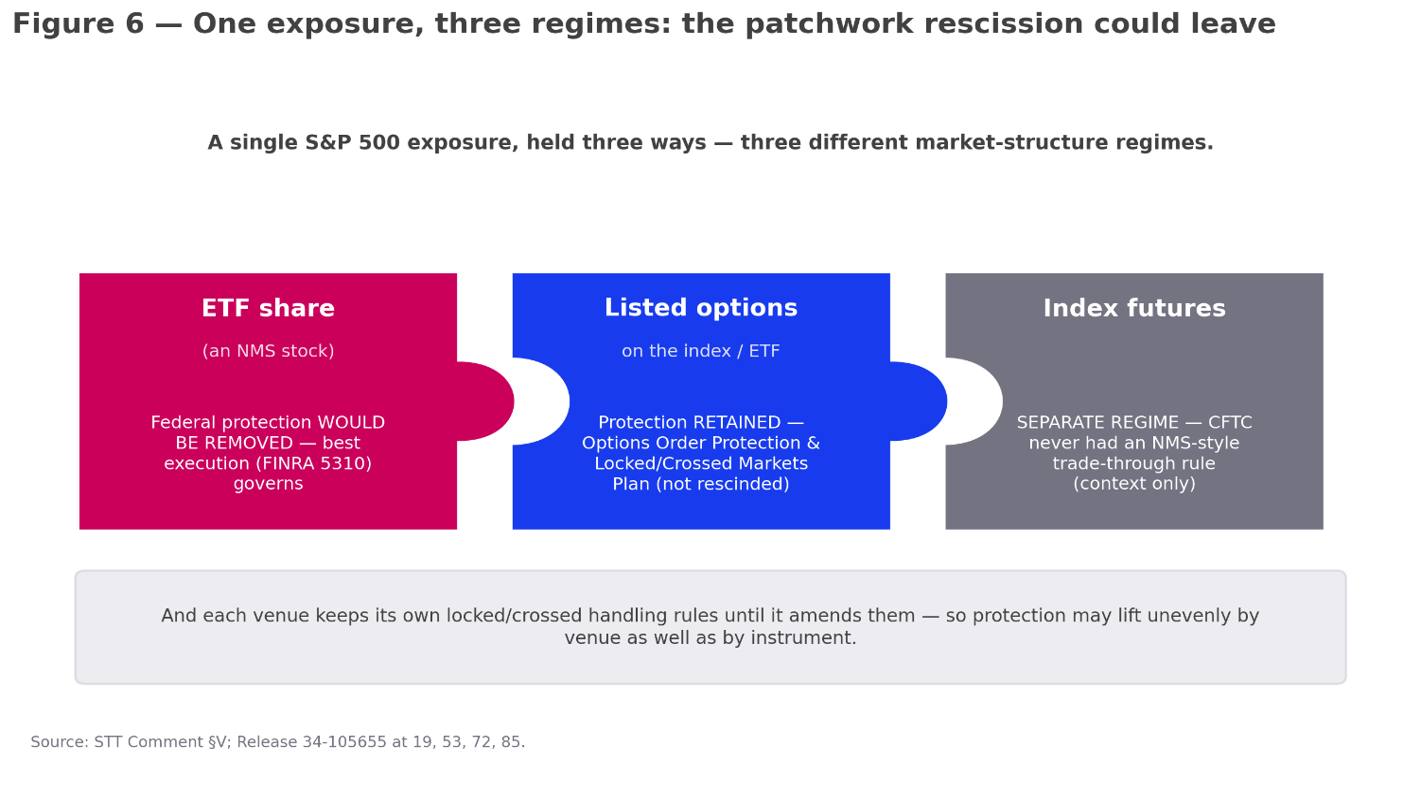
The divergence grows wider once you look across instruments that track the same economic exposure. The proposal reaches NMS stocks, but listed options are excluded from the definition of an "NMS stock" and keep their own trade-through and locked/crossed protections under the Options Order Protection and Locked/Crossed Markets Plan, a Commission-approved NMS Plan the proposal leaves untouched and to which its conforming amendments to Rule 600 still refer.³ So the same rule change that strips federal protection from a stock leaves that protection fully in place for the stock's listed options.
Figure 6 follows a single exposure (the S&P 500) through the result. Hold it as an ETF share, itself an NMS stock, and federal price protection would fall away. Hold the exposure through listed options on the index or the ETF, and the options plan keeps that protection in force. Hold it through index futures, and you are in a different regulatory world entirely: the CFTC's, under a market structure that never had an NMS-style trade-through rule to begin with. (We raise the futures leg only as context: it is expressly not part of this rulemaking, but the picture is the point.)³ One economic bet, three different sets of market-structure rules, arriving as the by-product of a change meant to simplify.
Beneath the instrument-level divergence sits a venue-level one. Individual exchanges, NMS Stock ATSs, and single-dealer platforms each keep their own rules for handling orders when the market is locked or crossed, and those persist until each venue chooses to change them.⁴ So protection could lift not only unevenly across instruments but unevenly across venues: a genuine patchwork in both directions, which is the opposite of the tidy simplification the proposal is reaching for. Our recommendation follows directly: the Commission should tackle the residual regimes within its reach head-on, including the affected NMS Plans, so that the federal rules, the SRO and exchange rules, and the cross-asset protections all move as a single set rather than drifting apart.
Should Broker-Dealers Wait for a Final Rule Before Preparing?
No. None of this argues for sitting still until a final rule lands. If anything, the operational weight is the argument for the opposite. The reconfiguring, re-testing, and validating described above is the same work whether a firm does it deliberately and ahead of time or scrambles through it under a deadline afterward, and the firms that start mapping now are the ones that will move with intent when the rule changes. In practice, that means taking stock of venue connections and order-type mappings, reviewing the routing and best-execution controls those rules touch, and identifying where the firm trades economically linked instruments that would land under different regimes. The change rewards preparation, and it punishes improvisation.
Closing
Conditions 3 and 4 are, at bottom, about sequence: making sure the federal rules, the SRO and exchange rules, firms' own systems, and the protections that surround related instruments all move in step, so that pulling complexity out of one part of the market does not quietly push it into another. For a firm that trades across instruments and venues, that sequence is also a planning horizon: a chance to be ready before readiness is required.
One thing, though, does not move at all when Rule 611 goes, and it is worth ending the series there.
Next: What doesn't change: pre-trade risk controls, Rule 15c3-5, and how this series will track the rulemaking.
Footnotes
1. Sterling Trading Tech, Comment on File No. S7-2026-20 (Aug. 10, 2026), §IV (reconfigure, test, and validate routing against each affected venue; adequate transition period; time the rescission of Rule 610(e) together with Rule 611); Release 34-105655, Request for Comment 11.
2. Id. §V; Release 34-105655 at 53 ("if the Commission rescinds Rule 610(e), the exchanges would still have those rules"); see also Request for Comment 13 (at 45).
3. Id. §V; Release 34-105655 at 19 (listed options excluded from "NMS stock"; Options Order Protection and Locked/Crossed Markets Plan, a Commission-approved NMS Plan the proposal does not rescind) and at 72 (Rule 600 conforming amendments retain the reference). Futures raised as context, not within this rulemaking.
4. Release 34-105655 at 85 ("[s]ome exchanges, NMS Stock ATSs, and SDPs have special rules for handling orders and executions when the NBBO is locked or crossed").
We look forward to learning more about your trading needs.

Preparing for a Post-611 World: Transition, Routing, and the Patchwork
Blog Series: The 611 Question | Part ...

Sterling Risk & Margin Wins Best Margining Solution at Risk Asia Awards 2026
Award recognizes Sterling’s real-time margin management for brokerages and trading firms ...

When 611 Is Gone, Best Execution Is the Safeguard
Blog Series: The 611 Question | Part ...

Sterling's Position: Support, With Five Conditions
Blog Series: The 611 Question | Part ...
