Oct 22nd, 2026


This post is the third in our series examining the SEC's proposed rescission of Rules 611 and 610(e) of Regulation NMS.
Earlier in this series:
Post 1 What the SEC Is Proposing, and the Cost Structure Rule 611 Built LINK HERE
Post 2 Sterling’s Position: Support, With Five Conditions LINK HERE
Introduction
Every rule change eventually comes down to a single order meeting a single quote, and that is where this post lives. The first two posts in this series laid out the proposal and where we stand; the proposal's premise is that today's automated, interconnected markets no longer need Rule 611 to backstop best execution.¹ We agree the market has changed. But two of our five conditions sit precisely where a connected market and a well-executing market part ways, a distinction that is easy to overlook. This post takes up those two conditions together: why connectivity is not the same as intelligent routing, and why, once Rule 611 is gone, the duty of best execution (and the data underneath it) has to carry the weight the rule used to.
Is Market Connectivity the Same as Intelligent Order Routing?
No, connectivity and intelligent routing are two different layers, and the SEC's proposal treats them as more interchangeable than they are. Consider what has to happen for a crossed market to resolve. Suppose a bid on one venue is momentarily higher than an offer on another: a crossed quote, a small pricing contradiction between two places. For that cross to clear, someone must notice it and act: route an order to capture it, or adjust a quote in response. The proposal is optimistic that this happens on its own, reasoning that any confusion from crossed markets "should be mitigated by today's routing technology, speed of execution, and the resulting rate at which crossed markets are resolved."¹ Our response is that this quietly runs together two things that are not the same.
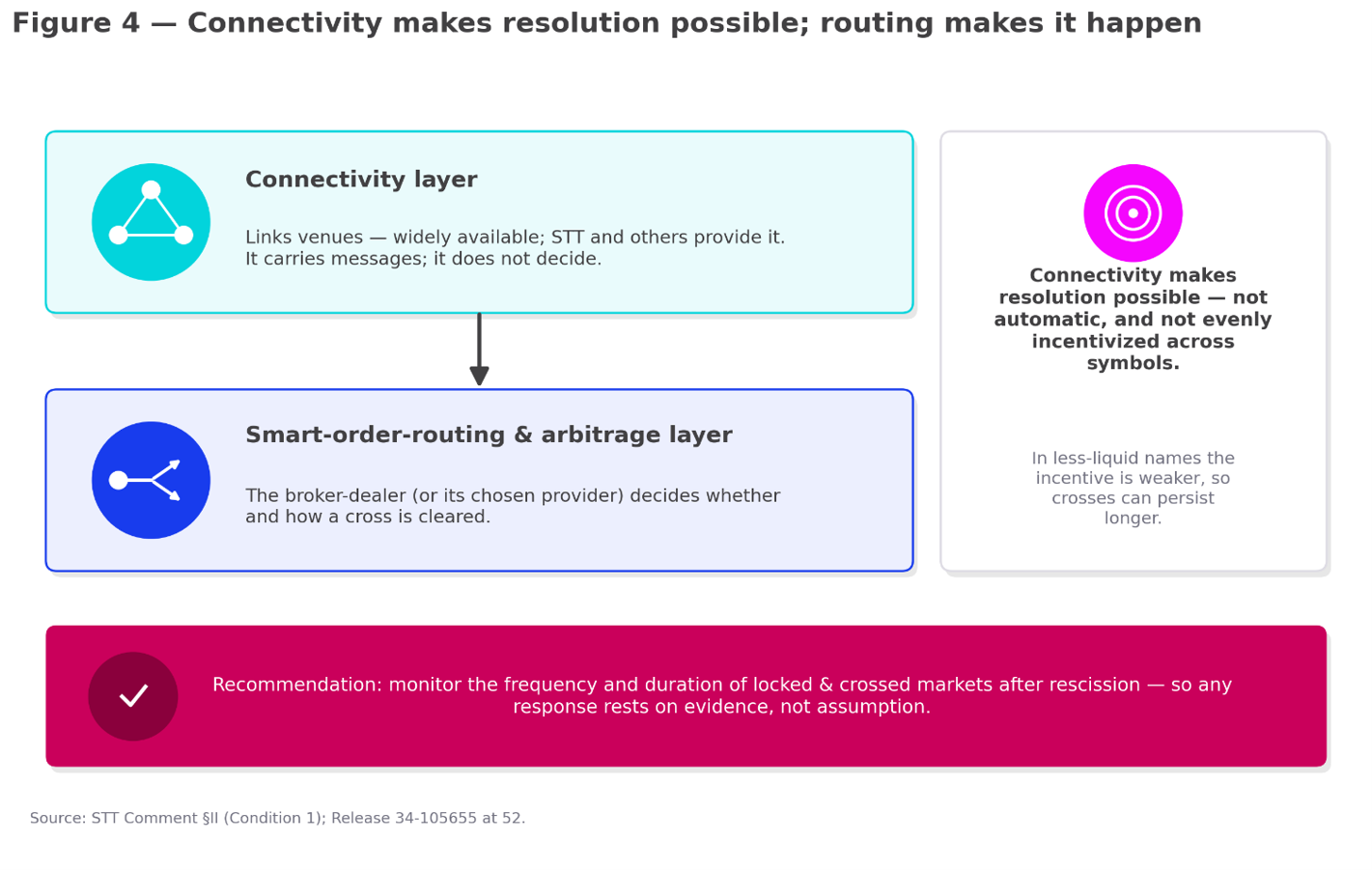
Figure 4 pulls them apart. The lower layer is connectivity, the wiring that links a firm to the venues. That layer is genuinely commoditized and widely available; we and others provide it, and the proposal is right that it is nearly everywhere. But connectivity only carries messages. Deciding whether to act on a cross (whether it is worth routing an order to clear it) happens in a separate layer: the smart-order-routing and arbitrage logic run by the broker-dealer or its chosen provider. Connectivity makes resolution possible; it does not make it automatic, and, crucially, it is not evenly incentivized across every symbol.¹
That last point is where the reassurance thins out. In a heavily traded name, plenty of participants are watching, and a cross is arbitraged away almost instantly because doing so is profitable. In a thinly traded name, the incentive to chase a small, fleeting cross is weaker, fewer eyes are on it, and a crossed or locked market can persist noticeably longer. The comforting average resolution rate the proposal leans on is carried by the liquid names, and it can mask what happens in the quieter corners of the market. So we make two modest asks: that the Commission not treat near-instantaneous self-correction as a settled fact, and that it commit to actually measuring the frequency and duration of locked and crossed markets after rescission, so that if the quiet corners do misbehave, any response rests on evidence rather than on the assumption that they won't.¹
What Protects Investors If Rule 611 Is Rescinded?
If Rule 611 is what currently guarantees that an order will not be executed through a better price, then removing it raises the obvious question: what guarantees it instead? The answer, and the reason Condition 2 exists, is the broker-dealer's duty of best execution under FINRA Rule 5310.⁴ That duty does not disappear when the trade-through rule does; it moves to the front line. Where the market used to enforce price protection structurally (for every firm at once, as a property of the system), it will now be enforced firm by firm, through each broker-dealer's own order-handling process. That is a workable arrangement, because best execution is a long-established obligation. But it changes where the burden sits, and it raises the stakes on something less visible than a rule: data.
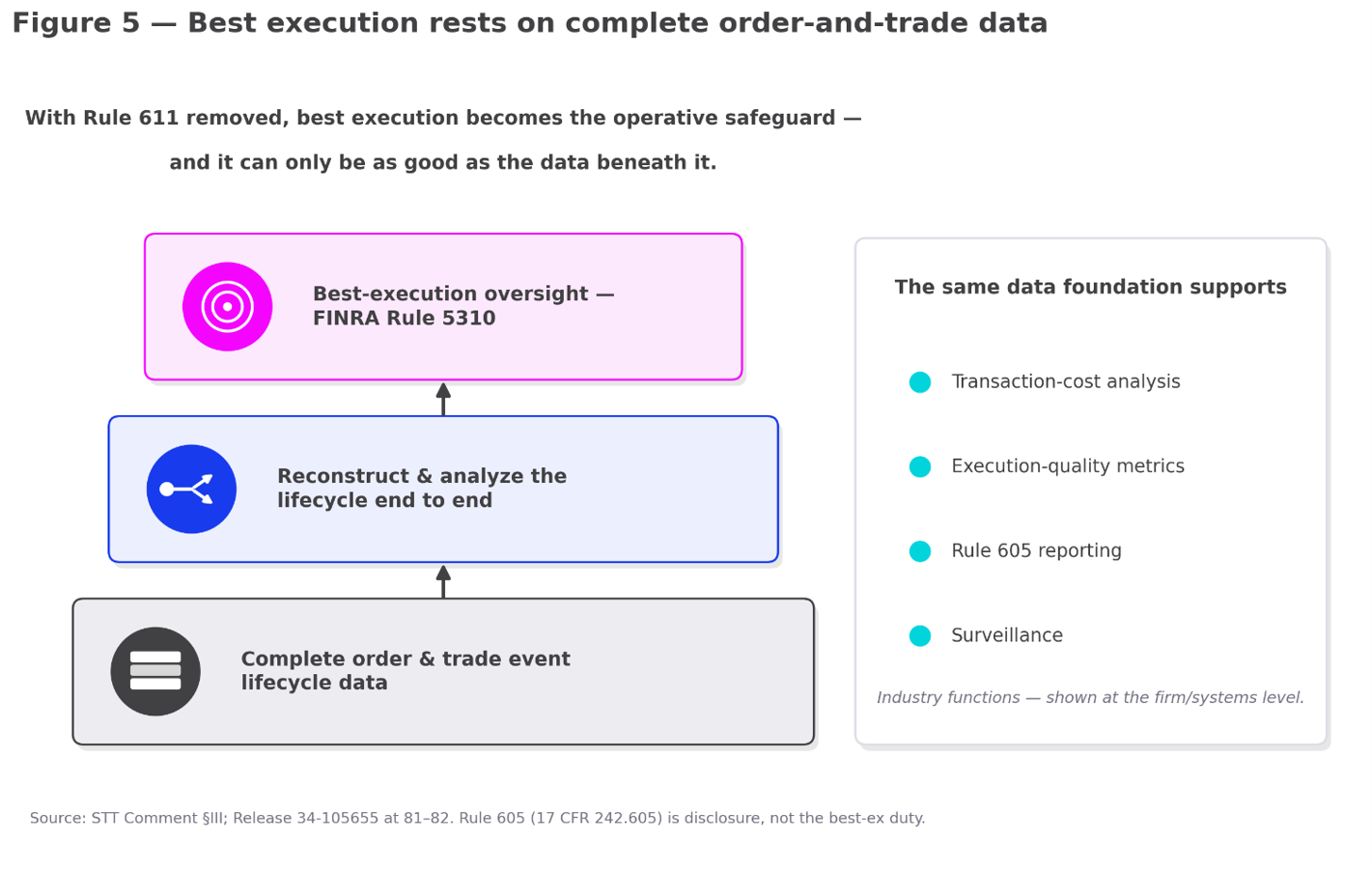
Figure 5 is really a picture of what best execution rests on. At the base is the complete record of what happened to an order and the trades around it: the full order-and-trade event lifecycle. Above it sits the ability to reconstruct and analyze that lifecycle end to end. And only with both of those in place can a firm actually demonstrate that it sought the most favorable terms reasonably available: best-execution oversight under Rule 5310. Remove the foundation and the rest of the stack has nothing to stand on; a firm cannot evidence a decision it cannot reconstruct.
None of this is hypothetical or new. The Commission's own record notes that firms already match their order and trade records against historical or real-time market data to monitor compliance with Rule 611 today, and with related FINRA rules including Rule 5310, using essentially the same tools and data they would use to surveil for a broad range of issues.³ Our point, from our vantage as a provider of systems that capture the order and trade event lifecycle, is simply that this foundation becomes more load-bearing after rescission, not less: the same data that used to help prove compliance with an external mandate becomes the primary way a firm proves it met its own best-execution duty. It is also the foundation on which transaction-cost analysis, execution-quality metrics, and surveillance all rest: industry functions, described here at the level of the firm and its systems rather than any single product.²
Two recommendations follow from that. The first is that any best-execution guidance should be principles-based rather than prescriptive. A detailed new rulebook, however well intentioned, would risk re-growing exactly the order-type proliferation and complexity the proposal is trying to prune, replacing one rigid structure with another. The second is that related execution-quality reporting should be kept coherent as these rules come down. Rule 605, for instance, is a disclosure regime about execution quality; it is not itself the best-execution duty, and the two should not be allowed to blur together as the surrounding rules change.⁴
Closing
The bottom line of this post is that rescission does not so much delete the protection Rule 611 provided as move it from a structural mandate that applied to everyone at once to each broker-dealer's own best-execution process and the data beneath it. That is a reasonable place for the protection to live, provided two things are true: that we treat crossed-market resolution as a routing decision rather than an automatic reflex, and that firms get guidance which recognizes what best execution now depends on. Get those two right, and the safeguard survives the transition intact.
Which leaves the very practical question of how the transition itself is run, and whether the market that emerges on the other side is genuinely simpler, or merely complicated in new ways.
Next: Preparing for a post-611 world transition, routing, and the patchwork.
Footnotes
1. Sterling Trading Tech, Comment on File No. S7-2026-20 (Aug. 10, 2026), §II (connectivity vs. intelligent routing; connectivity "makes resolution possible" but not "automatic" and "not evenly incentivized across all symbols"; monitor locked/crossed markets after rescission); Release 34-105655 at 52 (crossed markets "mitigated by today's routing technology, speed of execution, and the resulting rate at which crossed markets are resolved").
2. Id. §III (best execution becomes the operative safeguard; "systems that capture the complete order and trade event lifecycle"; principles-based guidance; Rule 605 coherence).
3. Release 34-105655 at 81–82 (firms match order and trade records against historical or real-time market data to monitor compliance with Rule 611 and related FINRA rules, including Rule 5310).
4. FINRA Rule 5310 (best execution); Rule 605 of Regulation NMS, 17 CFR 242.605 (execution-quality disclosure).
We look forward to learning more about your trading needs.

When 611 Is Gone, Best Execution Is the Safeguard
Blog Series: The 611 Question | Part ...

Sterling's Position: Support, With Five Conditions
Blog Series: The 611 Question | Part ...

Sterling Trading Tech and Atlas Digital Markets Turn Order Data into Best Execution Evidence
Clients measure execution on their own complete order data inside the Sterling OMS 360 and ...

What the SEC Is Proposing, and the Cost Structure Rule 611 Built
Blog Series: The 611 Question | Part ...
