Nov 5th, 2026


This post is the fifth in our series examining the SEC's proposed rescission of Rules 611 and 610(e) of Regulation NMS.
Earlier in this series:
Post 1 What the SEC Is Proposing, and the Cost Structure Rule 611 Built LINK HERE
Post 2 Sterling’s Position: Support, With Five Conditions LINK HERE
Post 3 When 611 Is Gone, Best Execution Is the Safeguard LINK HERE
Post 4 Preparing for a Post-611 World: Transition, Routing and the Patchwork LINK HERE
Introduction
The four posts in our series covered what the proposal would take away and where the weight lands once it is gone. It ends on something the proposal deliberately leaves standing. Condition 5 of our letter is the shortest of the five and, in a way, the most clarifying: it is about a safeguard that has nothing to do with trade-through at all, and a request that a routine edit not accidentally disturb it.
Does Rescinding Rule 611 Affect Pre-Trade Risk Controls Under Rule 15c3-5?
It should not, and that is precisely the point of Condition 5. Because the proposal touches several rules, it makes conforming amendments to Rule 15c3-5 (the market-access rule) to strip out references to the provisions being rescinded. We support those edits, with one careful caveat: keep them purely conforming. The Commission should confirm that removing the cross-references does not, even inadvertently, alter the substance of what Rule 15c3-5 requires, because those pre-trade risk-control obligations are independent of trade-through protection and remain important to market integrity in their own right.¹ The independence is easy to see once the two rules are set side by side.
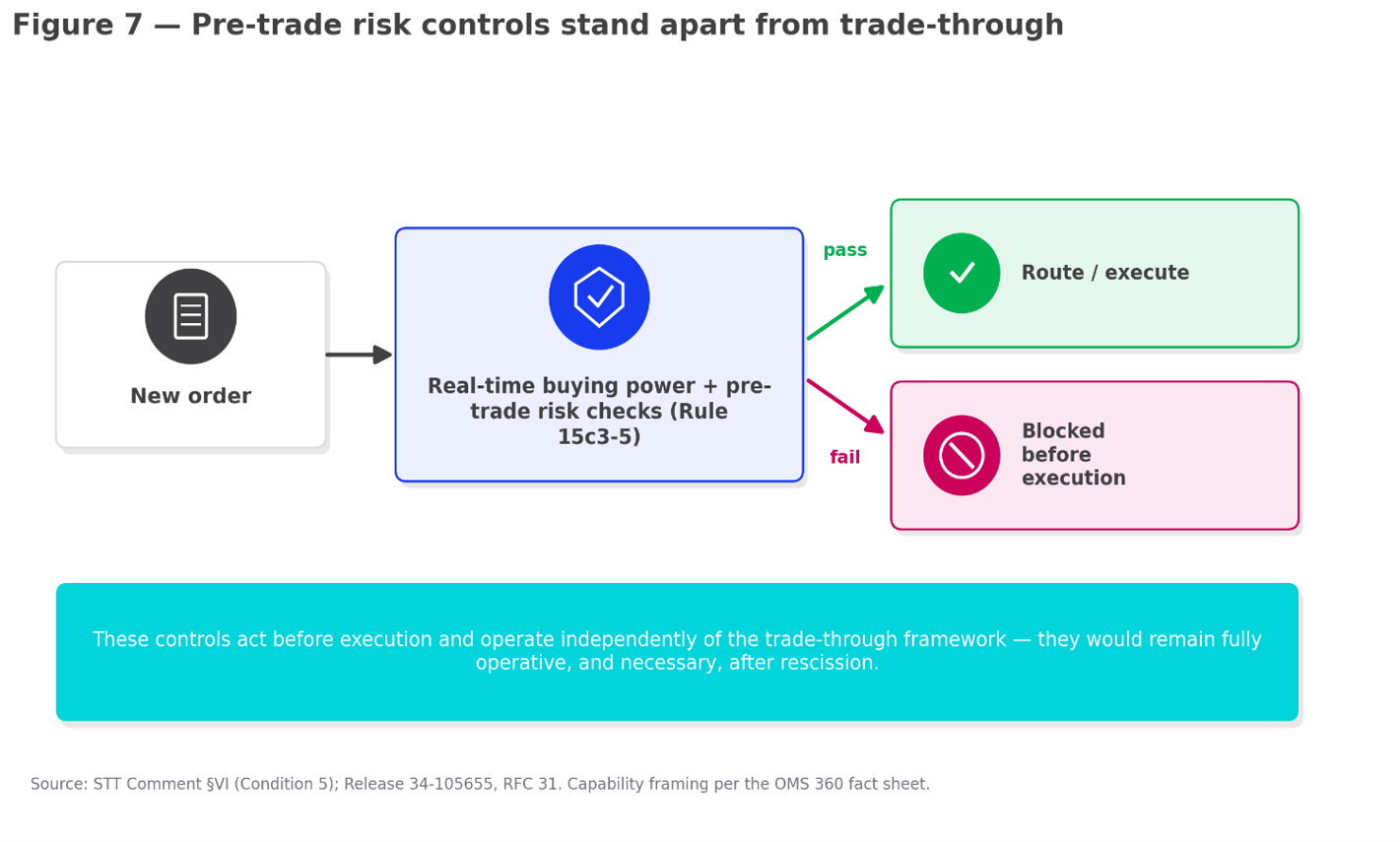
Figure 7 places a pre-trade risk check where it actually sits in an order's life: before the order goes anywhere. A firm computes buying power and applies its risk checks the moment an order is entered, and if the order would breach a limit, it is blocked before it can ever reach a venue. Whether an intermarket price-protection mandate exists downstream does not affect that decision. The two rules govern different questions at different moments. Trade-through is about which venue's price an execution may cross, once an order is in the market; Rule 15c3-5 is about whether an order should be allowed into the market in the first place. Remove the first and the second is untouched, because they were never doing the same job.
We can speak to this directly, as a provider of systems that perform pre-trade risk controls and real-time margin and buying-power computation: these controls run independently of the trade-through framework, and they would remain fully operative and, in our view, necessary after rescission.² In our own order-management technology, these are present-day capabilities: pre-trade checks that can block orders before they execute, and position and buying power computed in real time rather than from a prior-day snapshot.³ The point of Condition 5 is not that pre-trade controls need defending on the merits (no one disputes that they matter), but that a housekeeping change aimed at trade-through should not reach over and quietly re-engineer a rule that was never in its path.
Why It Matters
The larger reason to insist on this is that clarity is itself a form of protection. The proposal narrows one obligation, intermarket price protection, while leaving another, pre-trade risk control, fully in force. A conforming amendment that blurred that boundary would trade one kind of complexity for another and leave firms guessing about the scope of a rule that governs whether risky orders reach the market at all. Keeping the Rule 15c3-5 edits strictly conforming keeps the line bright: this rule is changing; that one is not. In a rulemaking whose whole purpose is to reduce confusion, a stray ambiguity in the market-access rule would be a self-inflicted wound.
What Happens Next in the Rulemaking Process?
It bears repeating, one last time, that everything in this series describes a proposal. Nothing has been adopted, and the "proposed" and "would" running through all five posts is deliberate rather than stylistic. The public comment file is substantial, and from here the Commission may respond to it, adopt a final rule, modify the proposal, or re-propose it altogether. (The four earlier posts on the proposal, our position, best execution, and the transition, together map what is at stake.) Market-structure change of this size rarely resolves in a single step.
So this is a beginning as much as a conclusion. As the rulemaking develops, through a final rule, through matching action by the SROs, through best-execution guidance, we will keep writing, in the same way the conversation around the intraday-margin rule kept going as new FINRA interpretations appeared. The public record may also raise themes that deserve a treatment of their own; the standards by which a quotation qualifies for the national best bid and offer, for instance, is the kind of question that could grow into a post in its own right.
Closing
We support the direction of this proposal and offer our five conditions in the spirit of a smooth, well-sequenced transition, and we welcome the chance to keep providing input as the rulemaking moves forward.⁴ If there is a single idea binding these five posts together, it is the one the series opened with and has kept returning to: taking a rule down is not the same as removing the job it was doing. A change that keeps its eye on where those jobs land (on best execution, on firms' systems, on the surrounding rules that must move in step, and on the controls that sit apart from all of it) can make the market simpler without making it any less safe. That is the transition worth getting right. Our full comment letter is available here (https://www.sec.gov/comments/S7-2026-20/s7202620-997559-3142729.pdf).
Footnotes
1. Sterling Trading Tech, Comment on File No. S7-2026-20 (Aug. 10, 2026), §VI (conforming amendments to Rule 15c3-5 should remain purely conforming; pre-trade risk-control obligations are independent of trade-through); Release 34-105655, Request for Comment 31.
2. Id. §VI (STT as "a provider of systems that perform pre-trade risk controls and real-time margin and buying-power computation"; such controls "operate independently of the trade-through framework" and would "remain fully operative and ... necessary after rescission").
3. OMS 360 Product Fact Sheet (cleared capabilities: "applies pre-trade checks that can block orders before they execute"; "computes position and buying power in real time").
4. Id., Conclusion.

We look forward to learning more about your trading needs.

What Doesn't Change: Pre-Trade Risk Controls, 15c3-5 and What's Next
Blog Series: The 611 Question | Part ...

Preparing for a Post-611 World: Transition, Routing, and the Patchwork
Blog Series: The 611 Question | Part ...

Sterling Risk & Margin Wins Best Margining Solution at Risk Asia Awards 2026
Award recognizes Sterling’s real-time margin management for brokerages and trading firms ...

When 611 Is Gone, Best Execution Is the Safeguard
Blog Series: The 611 Question | Part ...
